 Never Ending Movie Carnival
Never Ending Movie Carnival
Never Ending Movie Carnival
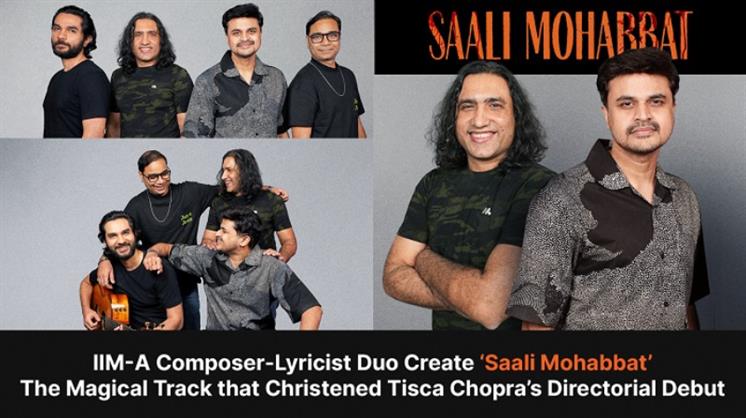
Team Hoopr in conversation with Cineblues
In a candid conversation with Cineblues, Team Hoopr comprising Gaurav Dagaonkar, Co-Founder & CEO of Hoopr, lyricist Abhimanyu Jha and vocalist Anirudh Bhola spoke extensively about how their data-driven platform and discovery model is helping filmmakers access original sounds while enabling independent artists to break into mainstream cinema—an emerging pipeline that is redefining how Bollywood finds its next generation of music talent.
Hoopr has marked a rare Bollywood first with ‘Saali Mohabbat’—a creator-led milestone where an IIM-Ahmedabad composer–lyricist duo delivered a song that not only features in Tisca Chopra’s directorial debut, but went on to become the film’s title.
Composed by Gaurav, the track was sourced entirely from Hoopr’s independent artist ecosystem—spotlighting a shift away from label-dominated music sourcing toward platform-led talent discovery.
1. Tell us about how you formed Hoopr and the journey from there on.
Hoopr was born out of a very personal moment. A music piece I composed was included in a big-brand promotional campaign in 2021 without my permission, credit, or remuneration. It was annoying but, over everything, it was revealing. I remember thinking that if this could happen to someone like me, with industry experience and visibility, then independent artists must be facing this far more often and with far fewer safeguards.
When I looked closer, the problem was systemic. India didn’t have a dedicated, India-first platform where brands and creators could easily discover and license high-quality, culturally relevant music in a legal and transparent way. At the same time, branded content and creator-led video were exploding at scale. Music was being used everywhere—but almost never licensed correctly.
That gap became Hoopr. We set out to make music licensing simple, fast, and accessible, while ensuring artists were paid fairly and transparently. Hoopr has developed into a comprehensive music licensing and brand solutions platform over the past three years—Hoopr has onboarded more than 1,500 artists, curated a catalogue of 15,000+ tracks, and disbursed ₹4.5+ crore in direct earnings to artists. Today, the platform supports ethical music usage for over 400,000 creators and 200+ brands, positioning Hoopr as one of the country’s most trusted digital licensing infrastructures. The path has not only been about product development; it has also been about shifting attitudes and demonstrating that moral music usage can grow in India.
2. Did you have a background in music before starting Hoopr? What prompted you to build a career in music and not in the corporate world, despite a PGDM from IIM Ahmedabad?
Yes—music has always been my first language. Even while studying at IIM Ahmedabad, I was writing and composing music, and one of my early songs, College Days, became extremely popular. When campus placements came around, I made a conscious decision to step away from the traditional corporate path and pursue music full-time.
It wasn’t an impulsive choice; it was a deeply intentional one. I wanted to understand the industry from the inside—how artists survive, how labels think, how brands use music, and where the system breaks down. Over the next 15 years, I worked across the ecosystem as a composer, singer, and producer, collaborating with artists, labels, and brands, and later founding Songfest to build music-led brand solutions at scale.
Ironically, that time away from the corporate world is what eventually brought everything full circle. Hoopr sits at the intersection of creativity, technology, and business—and my engineering background, IIMA training, and years as a working musician all came together to solve a problem I had personally experienced. It doesn’t feel like I left corporate life and returned to it; it feels like I built something far more meaningful using everything I learned along the way.
3. How did Saali Mohabbat happen?
‘Saali Mohabbat’ is deeply significant for us because it encapsulates everything Hoopr stands for in a single creative moment. The song was conceived, created, and brought to life entirely within Hoopr’s artist ecosystem. I composed the track, with vocals by Anirudh Bhola, musical collaboration by Atul Kumar Verma, and lyrics by Abhimanyu Jha—all artists from our network.
When the track was shared with Stage 5 Productions, it resonated instinctively with the emotional core of the story. The tone, depth, and vulnerability of the music aligned so seamlessly with te movie’s narrative that it went on to inspire the title of the film.
For Hoopr, this wasn’t just a soundtrack placement—it marked our Bollywood debut, driven entirely by independent talent. It reaffirmed our belief that artists outside traditional label systems can create work powerful enough to organically enter mainstream cinema. Saali Mohabbat became a full-circle moment: a song born within Hoopr, carried forward by its artists, and embraced by Bollywood purely on creative merit.
4. How did you catch the pulse of the plot and develop the music?
Restraint was central to my approach. Instead of engaging with the narrative intellectually, I chose to sit with the emotion that runs beneath it. ‘Saali Mohabbat’ is far more than its plot points or defining moments—it lives in the silences, in what’s felt between the lines rather than spoken aloud.
I approached the music almost as a conversation with the film itself. The goal was for the score to belong to the world of the story, not sit on top of it. That meant embracing stillness, allowing space, and resisting the urge to be overt or dramatic. There was a quiet intention behind every note—a conscious choice to let emotion breathe rather than overwhelm.
As a composer, my instinct has always been to serve the story first. And as someone who now builds platforms for artists, this process was a powerful reminder of why music holds such significance in storytelling. When it’s done right, music doesn’t merely enhance a narrative—it becomes inseparable from it, shaping its emotional core and leaving a lasting imprint on the audience.
5. How did the IIM Ahmedabad duo—Gaurav and Abhimanyu—come together for ‘Saali Mohabbat’? Was it a coincidence?
It ultimately came down to timing and creative alignment. Abhimanyu reached out at a moment when he was keen to write from a place of pure emotion, without constraints or predefined briefs. Almost simultaneously, the creative requirement for ‘Saali Mohabbat’ emerged. We spent time discussing the film’s emotional landscape and narrative intent in depth, and the lyrics took shape organically from that shared understanding.
Once the lyrics were in place, I began composing the track, which was then further developed within Hoopr’s artist ecosystem. Anirudh Bhola brought the song to life with his vocals, while Atul Kumar Verma added depth through his musical collaboration. When we shared the finished track with the film’s team, it resonated instantly with the story’s emotional core, eventually evolving into the film’s title track.
While the collaboration wasn’t conceived as an IIM-led project, it became a powerful example of how aligned creative thinking—when supported by the right platform and ecosystem—can naturally transition into meaningful, mainstream cultural work.
6. What as per you is the biggest challenge that the music-tech space is grappling with?
The central challenge facing music-tech today is the widening gap between scale and value. Technology has made music creation, distribution, and consumption infinitely scalable, but the systems that protect rights, ensure fair compensation, and uphold creative integrity have failed to evolve at the same pace. This disconnect is further reinforced by a deeply ingrained belief that music—particularly in digital and branded-content environments—is free to use. As music travels faster and farther than ever before, the creators behind it are often left with disproportionately little value in return.
Compounding this is the growing issue of catalogue dilution. The rapid influx of AI-generated tracks and low-cost music libraries has made discovery increasingly noisy and eroded trust across the ecosystem. When volume overtakes quality, and speed eclipses clarity of rights, music risks becoming generic, disposable, and legally ambiguous. The real test for music-tech companies today is not about building more tools or larger catalogues—it is about building trust. Trust that every use is legitimate, every artist is paid fairly, and creativity remains protected at the core of the ecosystem.
7. What would you advise the budding musicians and fellow entrepreneurs who are entering the music tech space?
For musicians, my advice is both simple and essential: treat your intellectual property as a long-term asset. Visibility alone does not build a sustainable career. It’s important to understand how your music is being used, where it is licensed, and whether it is generating real income. While a million streams or views can be validating, longevity comes from rights ownership, transparency, and recurring monetisation—not just reach.
For entrepreneurs entering music technology, the biggest lesson is to avoid chasing shortcuts. The industry does not suffer from a lack of platforms or features; it suffers from a lack of solutions that genuinely address ecosystem pain points. Build with artists, not at their expense. Your product should make life meaningfully easier for creators or significantly safer for brands—anything less will struggle to scale sustainably. Music may be emotional at its core, but the business surrounding it must be rigorous, ethical, and fair. When that balance is achieved, growth follows naturally.
8. How does Hoopr differentiate itself from other global licensing platforms?
Hoopr differentiates itself through a rights-first, globally compliant licensing framework that embeds royalty accountability into every single transaction. Every track on the platform is fully cleared, with licensing metadata seamlessly integrated with IPRS, ensuring artists receive their royalties transparently and on time. By design, Hoopr addresses one of the most fundamental gaps in music technology today: enabling music to be used at massive digital scale while ensuring creators are fairly and reliably compensated.
Beyond licensing, Hoopr plays a critical role in bridging independent talent with mainstream cultural ecosystems, including Bollywood. A defining example is Saali Mohabbat, where every artist involved was part of the Hoopr ecosystem—demonstrating how independent creators can move seamlessly into high-impact, film-grade projects through the platform.
In this way, Hoopr is not just facilitating legal music usage; it is actively powering the creation and circulation of culturally relevant music at a global standard. By providing access to independent talent capable of delivering film-quality music, Hoopr expands the opportunity set for artists while giving brands, creators, and filmmakers a trusted route to discover and deploy exceptional sound. Today, Hoopr stands not merely as a licensing marketplace, but as a full-stack music-technology platform shaping how music is created, distributed, and valued in the digital economy.

Ahwaan Padhee, is an IT Techie/Business Consultant by profession and a film critic/cinephile by passion, is also associated with Radio Playback as well, loves writing and conducting movie quizzes. More By Ahwaan Padhee