 Never Ending Movie Carnival
Never Ending Movie Carnival
Never Ending Movie Carnival
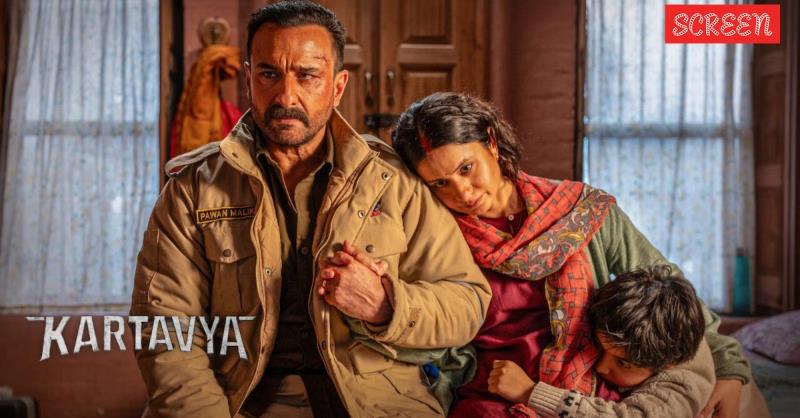
Saif Ali Khan spearheads a gritty drama with elan and conviction, while treading the complex dilemmas threaded in duty and family ties.
‘Kartavya’ is centered on the extreme measures exercised by the morally upright SHO Pawan (Saif Ali Khan) when he fails to save a journalist from unidentified assailants who visits his Jhamli village to report on the mysterious disappearances of kids from the Anand Bhoomi, run by a godman, Anand Sri (Saurabh Dwivedi aka Lallantop in his debut role). It deep dives into the moral grey where duty and conscience collide in a tense world where there is danger, deception and uncertainty lurking at every step. His source of cushion and consolation is his subordinate and buddy Ashok Y (Sanjay Mishra) at work, and his wife (played by Rasika Dugal) at home. Meanwhile, Pawan is grappled with a domestic trouble when he learns that his younger brother has eloped with a girl from another caste, while inviting furore from the village panchayat and the girl’s brother (played by Durgesh Kumar, of Panchayat fame).
Pulkit, who helmed films like Bhakshak, Dedh Bigha Zameen and Maalik, has an astute grasp on the Indian hinterland milieu and plants his stories and characters meticulously in the raw and rustic canvas, while drawing punchy and powerful performances from the entire star cast.
The lines are clap-traps and hit hard when Pawan exclaims with authority, “Niyat se Saaf, Mahadev ka Bhakt, upar se Policewala hoon”, reminding you of the swag he exuded in Omkara as the devious Langda Tyagi and seven years later in Tigmanshu Dhulia’s Bullet Raja (Brahman rootha toh Ravan!). The ‘homegrown rebel’ with the impeccable lingo, the dialect and the unmistakable gait fits quite naturally to Saif, although he has always carried the uber-cool metrosexual man effortlessly on his sleeves.
In one scene, he subjugates his boss vocally, Keshav (played by the immensely talented Manish Chaudhari) by screaming in decibels higher than him. In another, he almost assaults his father, Damodar (Zakir Hussain) and threatens him of dire consequences if he thinks of doing any evil to his eloped younger brother. He tries to cleanse himself and the system – the system of which he is the by-product of, an archaic system which subscribes to orthodox and rigid principles. A village whose Panchayat legitimises honour killing engineered in brutal ways and worships the diabolic godman, an unfair world where baalaks
(children) bear the brunt of the mistakes made by the elders. Kartavya emerges as a social diatribe against the dark truths that still skulk in our semi-urban territories and the inherent systemic rot.
I like Pulkit’s craft and the palpable tension he stages at every step in the world-building, but I aspired for a more explosive climax, like Maalik given the eruptive sparks during its narrative. Here, Pawan’s conflict is more internal, and the solution is contrived, convenient and confusing – hence making the Red Chillies Entertainment-backed project a tad underwhelming.

Ahwaan Padhee, is an IT Techie/Business Consultant by profession and a film critic/cinephile by passion, is also associated with Radio Playback as well, loves writing and conducting movie quizzes. More By Ahwaan Padhee